The Newest Development
of Evolutionary Computation

Gene Expression Programming: Mathematical Modeling by an Artificial Intelligence

By Candida Ferreira

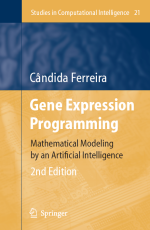
Read more about the 2nd edition of the first book on Gene Expression Programming by its inventor.
  What's New

  • The Gene Expression Programming Bibliography
  • GeneXproTools 4.0 R2. New Logistic Regression Analytics Platform
  • Maintenance release of GeneXproTools 4.0 and GeneXproServer 1.0
  • Automatically Defined Functions in GEP

  •     More news

     
    Subscribe to the GEP mailing list

     
    What is Gene Expression Programming?

    Gene Expression Programming (GEP) is a new evolutionary algorithm that evolves computer programs (they can take many forms: mathematical expressions, neural networks, decision trees, polynomial constructs, logical expressions, and so on). The computer programs of GEP, irrespective of their complexity, are all encoded in linear chromosomes. Then the linear chromosomes are expressed or translated into expression trees (branched structures). Thus, in GEP, the genotype (the linear chromosomes) and the phenotype (the expression trees) are different entities (both structurally and functionally), and because of this apparently trivial fact, this new evolutionary system can finally make a difference, successfully assisting researchers in the design of robust and accurate computer models.

    As in nature, the linear chromosomes of GEP consist of the genetic material that is passed on with modification to the next generation. This, in other words, means that in GEP all the genetic modifications take place in the linear chromosomes (much easier to do than in complex branched structures as is done in GP), and it also means that only the linear chromosomes are transmitted in the process of reproduction (linear strings are much easier to replicate than complicated tree structures). And also as in nature, it's only during development that the information encoded in the chromosomes is finally expressed into fully developed computer programs or expression trees (ETs).

    Expression trees are sophisticated computer programs that are usually evolved to solve a particular problem and are therefore selected according to their fitness at solving that task. With time, populations of such computer programs (encoded, of course, in linear chromosomes) will discover new traits (thanks to genetic modification) and therefore will become better adapted to the particular environment chosen for their breeding (this environment defines obviously the problem at hand). And this means that, given enough time and that we've set the stage correctly, a good solution to the problem at hand will be discovered.

    So, GEP is a full-fledged genotype/phenotype system, with the genotype totally separated from the phenotype. In Genetic Programming, though, we have a totally different scenario: genotype and phenotype are one entangled mess or what is more formally called a simple replicator system. And the consequences of this are huge: the full-fledged genotype/phenotype system of GEP surpasses the old GP system by a factor of 100-60,000!


    Learn More

    This might all seem very confusing, especially if you've forgotten your biology, but GEP is in truth very simple and can be quickly understood. To know all the details about this new algorithm, see the seminal GEP paper (published in the journal Complex Systems in 2001) where the algorithm is fully described and applied to a varied set of modeling problems. Or you can read the GEP online tutorial for a quick introduction to this revolutionary algorithm. Other online tutorials are also available for faster and more informal expositions.

    For more advanced topics, all my GEP papers are freely available online both in pdf format and html. The 1st edition of my GEP book is also freely available online, but you should also check the 2nd Springer edition which was substantially revised and extended with five new chapters, including a chapter describing two new algorithms for decision tree induction with GEP.


    GEP Software

    To see and understand how GEP really works, you can download Gepsoft GeneXproTools 4.0. The freely available Demo is fully functional for a wide set of sample problems. And this means two main things: First, you can visualize and monitor lots of interesting things during evolution, including the evolutionary dynamics, fitness distribution, program size distribution and variation, instant curve fitting and target/model comparison, variables usage, program structure (not only the expression trees but also the corresponding code in Ada, C, C++, C#, Fortran, Java, Java Script, Matlab, Pascal, Perl, PHP, Python, Visual Basic, VB.Net, and VHDL), model generalization, and so on.

    And second, with GeneXproTools you can experiment with a lot of settings and see immediately how a particular setting affects evolution. For example, you can change the population size, the genetic operators, the fitness function, the chromosome architecture (program size, number of genes and linking function), the function set (more than 250 built-in functions to choose from), the learning algorithm, the random numerical constants, the rounding threshold, experiment with parsimony pressure, explore different modeling categories (function finding, classification, time series prediction, and logic synthesis), change the seed structure, simplify the evolved models, explore neutrality by adding neutral genes, create your own fitness functions, design your own mathematical/logical functions and then evolve models with them, and even create your own grammars to generate code automatically from GEP genes in your favorite programming languages, and so on.


    ***

    Subscribe to the GEP mailing list.
    Please enter 2 + 32 =

    Last update: 15/May/2008
     
    © Candida Ferreira
    All rights reserved.